Yoga Combined With Bhagavad Gita Teaching Significantly Reduces Anxiety in Healthcare Workers, New Study Finds
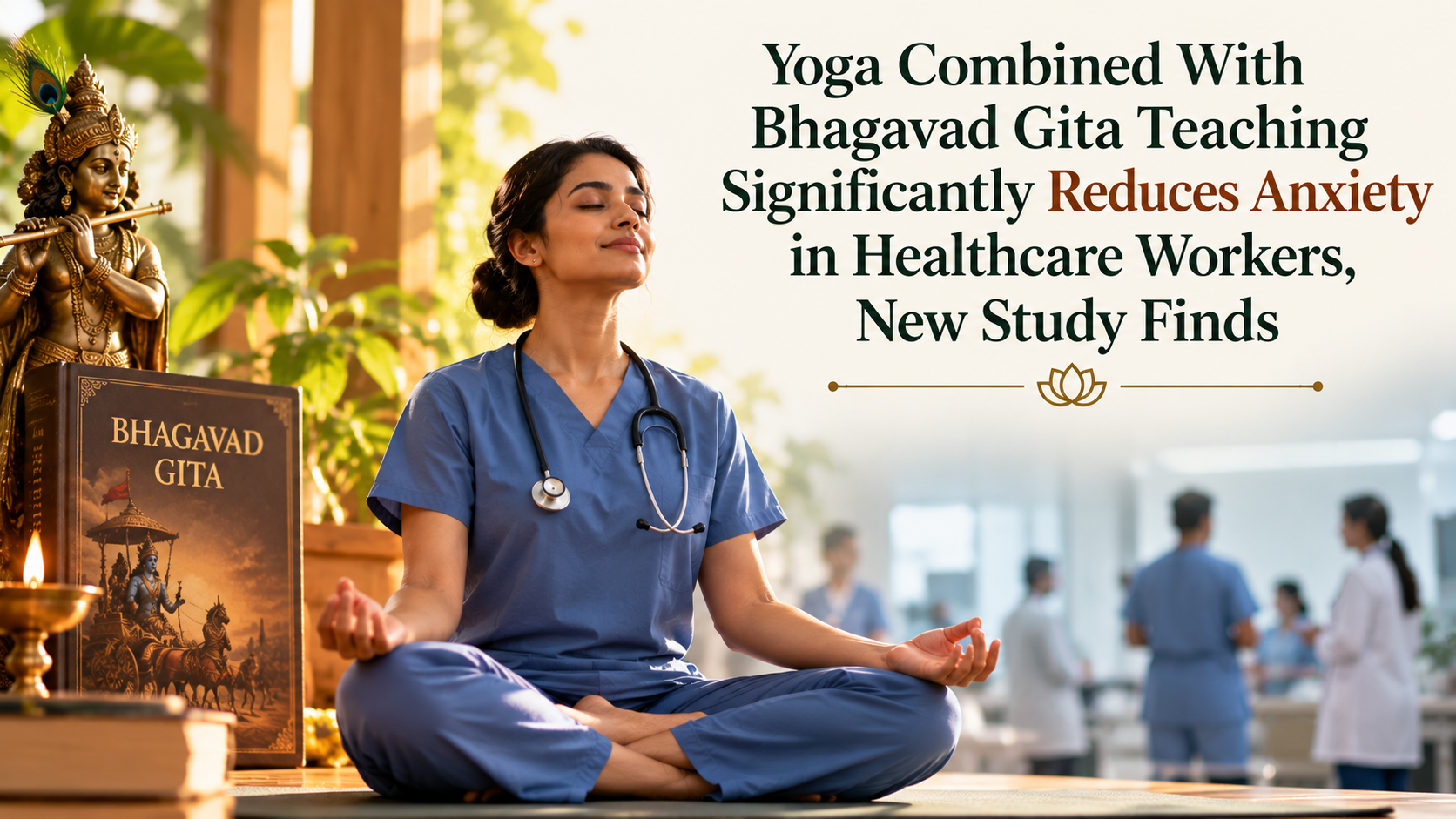
Yoga Combined With Bhagavad Gita Teaching Significantly Reduces Anxiety in Healthcare Workers, New Study Finds

A prospective, single-center randomized controlled trial published in PLOS One (April 2026) has demonstrated that integrating physical yoga practice with philosophical and spiritual teachings from the Bhagavad Gita yields statistically significant reductions in psychological distress among healthcare workers (HCWs)[cite: 1].
Conducted by researchers across academic and medical institutions including the Indian Institute of Technology (IIT) (ISM) Dhanbad and Flinders University, the study addressed a critical post-pandemic challenge: elevated burnout and anxiety among frontline medical professionals who often underutilize conventional mental health support services due to stigma[cite: 1, 2, 3].
Trial Design and Intervention Groups
The study evaluated 68 eligible healthcare workers at a secondary hospital in Jharkhand, India, randomized in a 1:1:1:1 ratio across four distinct arms (17 participants per group)[cite: 1, 3, 4]:
- Yoga Group: Attended daily 60-minute sessions for one week, covering physical postures (asana), breathing control (pranayama), and meditation (dhyana)[cite: 3, 4].
- Gita Group: Attended daily 60-minute sessions for one week focusing on learning and discussing Chapter 2 of the Bhagavad Gita, delivered by trained instructors using the text Bhagavad-Gita As It Is[cite: 3, 4].
- Yoga + Gita Group: Participated in a combined 60-minute daily session consisting of 30 minutes of yoga followed by 30 minutes of Bhagavad Gita instruction[cite: 3, 4].
- Control Group: Received usual care with no active intervention[cite: 3, 4].
Psychological distress was measured using the 7-item Generalized Anxiety Disorder (GAD-7) scale at baseline, immediately post-intervention (Day 8), and at a delayed 45-day follow-up (Day 52)[cite: 1, 5, 6].
Key Findings: Immediate vs. Sustained Relief
The trial revealed distinct temporal benefits between physical practice and cognitive-spiritual reframing[cite: 13]:
- Immediate Effects: Compared with the control group, the combined Yoga+Gita intervention produced a statistically significant reduction in anxiety scores immediately post-intervention (p = 0.009)[cite: 1, 6]. Researchers noted that physical yoga practice helps downregulate the sympathetic nervous system, offering rapid somatic relief from physical tension[cite: 13].
- Long-Term Durability: At the 45-day follow-up, the Gita-alone group demonstrated a statistically significant reduction in anxiety compared to controls (p = 0.047)[cite: 1, 6]. Furthermore, clinically meaningful reductions (defined as a ≥4-point drop on the GAD-7 scale) were observed in 47.1% of the Gita group and 41.2% of the Yoga+Gita group, compared to just 11.8% in the control arm[cite: 1, 8].
Exploratory sub-analyses also indicated that women experienced more substantial score reductions, particularly within the spiritually-focused arms, and participants who maintained regular practice after the intervention showed superior long-term outcomes[cite: 9, 11].
Implications for Culturally Grounded Healthcare Support
The study highlights the limitation of Western-centric, secular mental health models in culturally distinct settings where healthcare professionals experience high social stigma regarding formal psychological help[cite: 3, 13]. By anchoring interventions in familiar philosophical frameworks—such as the duty, detachment, and emotional stability taught in the Bhagavad Gita—hospitals may successfully bypass barriers to mental health engagement[cite: 3, 13].
The authors conclude that combining somatic practices like yoga with cognitive-reframing frameworks offers a scalable, culturally resonant model to protect the psychological well-being of frontline personnel[cite: 1, 13].